Sunday, April 18, 2010

First impression review: Minibulldesign Bongo HNC

The US cottage manufacturer Minibulldesign specializes in ultralight alcohol stoves and pots. "Tinny" which he calls himself in his youtube videoes, or John Austin which I gather is his real name, is the designer and producer of the stoves and I think his wife is part of the operation too, handling some of the order taking, shipping etc. Besides making stoves, hiking and in other ways enjoying life, he produces a youtube video each and every day. His channel has 532 uploads so far which is pretty impressive. In his videos he discusses stoves, everyday life, hiking, gear, ultralight techniques etc. Here's he making noodles with the Bongo before discussing the design:


I like that he makes several of his stoves and pots out of different aluminium cans, which makes them very lightweight and cheap. Some of his stoves, like the Bongos, are more time consuming to produce and requires metal working skills which he apparently has a lot of (from his previous job?). Here's the first part of a video he made recently to explain why he charges 75 dollars for his premium stove, the Bongo Pro:


The first minibull design stove I purchased was the Atomic (10 US dollars) which I thought was ok. I ended up putting it in the pay-it-forward box "The Scandinavian Mystery box". Don't know where it is now :).

A week or two ago I received a Bongo HNC stove (35 US dollars) which I've been curious about for some time. I considered getting the Bongo Pro, but felt 75 dollars was a little bit too much.


The Bongo is pretty unique I think. It has a remote fuel container in the form of a plastic bottle with a fuel line running from the cap to the lower part of the stove. The stove itself has a bottom part connected to an upper part with a silicone sleeve. Fueling is done by squeezing the fuel bottle until the carbon felt wick gets shiny. It doesn't need priming and will the burn for 4-5 minutes on one filling. When the stove gets low on fuel the wick will start to glow as shown in the picture below. It is then just a matter of squeezing the bottle again, but being careful not to overfill it. If that happens the silicon sleeve may melt and you'll be in a world of pain.


I've done a couple of boil tests so far. The first ones I did it outside on my veranda in around 5 degrees celsius with a wind screen. 2 cups of water took around 12 minutes to a rolling boil with the Snow Peak 600 pot and wire stand. In the protected environment of my kitchen I got a rolling boil in 10:30. This is obviously not a very hot burning stove, so you have to be a bit more patient waiting for your water to boil. This has a postive side however in that it is nice to use to fry pancakes etc. which requires a lower heat.


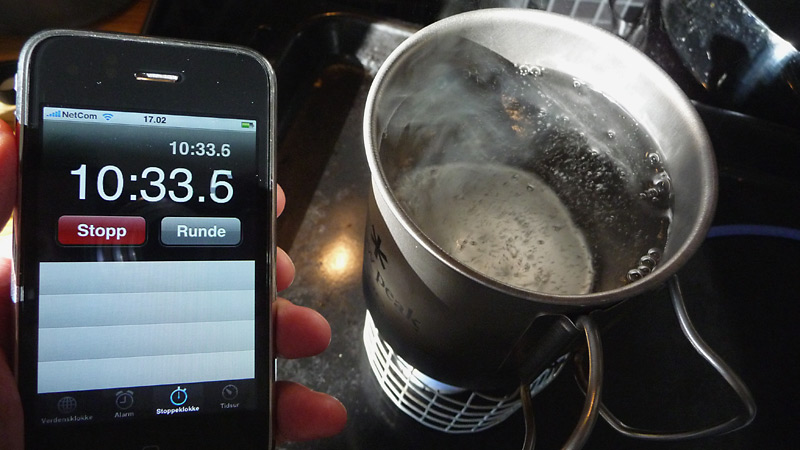


I didn't measure the fuel usage, but I think it is pretty average for an alcohol stove.

This is a fun little stove that I'll probably use from time to time, and a welcome addition to the collection. I've long since realized that I'm becoming a collector of stoves!.

To sum up:

Positives:
- very light and simple
- easy to operate
- low heat output suitable for more delicate cooking, and is less daunting for a beginner than other very hot burning stoves
- spare parts can be bought and he has a kind of modular system going where you can mix parts
- very easy to blow out
- easy to see when the fuel runs low, will burn/glow for a long time before going completely out, so you don't have to babysit it
- relatively cheap considering the flat international shipping rate of 3 dollars!
- nice to get two extra fuel bottle caps. Would suck to lose one on the trail and not have a backup
- comes with easy to understand instructions

Negatives:
- slow compared to other stoves
- needs a pot stand (the pro version comes with a set of pins to insert in the base so you get an integrated pot stand)
- fuel line could have been longer to make it easier to have the fuel bottle standing up and having it be farther away from the burning stove
- not perfect finish on the aluminium work, but personally I think its plenty nice enough and in no way affecting the performance. Thought I should mention it anyway
- takes a long time to burn completely out, but maybe that's not really necessary. I think I read that fuel can be reclaimed from the stove somehow.

Hope you liked this short review - have a nice week!

Thursday, March 25, 2010

Life in a tree house

Found this interesting video via Alastair Humphrey's blog. It's a short presentation by a guy named Nick Weston who built his own tree house in the woods and lived off the land for 6 months.

Wednesday, March 24, 2010

How to hank cordage

I guess most of us have experienced a mess of tangled up guylines after not doing a tidy job of packing down a tarp or tent. A way of preventing this is to "hank cordage", creating nice bundles that can be quickly released. There are several ways to do this - the method I'm using is the one demonstrated in the "Tarp DVD" by backpackinglight.co.uk.

Recently there was a thread about this at hammockforums.net and I contributed by making this short video to demonstrate how I do it:


How do you guys do it?

Monday, March 22, 2010

Spending money where it makes a difference

Most of the time I think spending extra to buy light and high quality stuff is a wise move, but sometimes I see products that are just ridiculously priced and with no real benefit or advantage compared to a lower priced one.

Case in point, I stopped by the sports store XXL today to buy some shoes and while standing in line I remembered needing a long handled spoon, and having seen one earlier in the hiking/backpacking setion of the store. I had planned to get one from BPL, but I don't think they'll ever get back in stock? Well, I went to find it and the first thing I saw was a "STS Titan long spoon" from Sea to Summit with a price tag of 239 norwegian kroner! (40 USD). I was thinking "ah, ok, that sort of explains why I haven't picked one up earlier", and was about to leave when I saw a similar model from the same manufacturer made out of "ultralight hard anodised aircraft alloy" at a price of 89 kroner (15 USD), and it looked just as great and I of course bought it.


Why on earth would I want to spend 25 USD extra on the ti version to save 5 grams in weight? The aircraft alloy (aluminium) version will of course be just as durable and the weight difference is miniscule. I really hope people don't buy invest in this stuff and instead spend their money one one of the big three (shelter, pack, sleeping bag) to get their base weight down.

Well, anyhow, rant over. I really like the spoon and I think it will make it a lot easier to get the last good bits out of the "Real Turmat" bags. Oh, and I like the small carabiner that comes with it. Probably smart to use it to clip the spoon to the pack or something so it won't be lost, or to use for other purposes, for instance hanging stuff from a tarp ridgeline.

Thursday, February 25, 2010

Warm, but not very durable

I first heard of Possumdown when reading about the often mentioned Possumdown gloves + MLD event rain mitts combo. It's been recommended by many hikers, including Andrew Skurka, and claimed to be good for four season use. That made me curious so I of course had to try them out.

I haven't had the chance to try the MLD rain mitts, but the Possumdown gloves have been used during the winter, mostly as an everyday glove to and from work etc. The short story is that I find them warm, but with some serious durability issues when worn alone. I've been forced to repair some of the fingertips with some zig zags, and that has been sufficient, but new ones keep appearing. So, not something you would want to choose for a long thru-hike.


On the positive side - these are warm, light and comfortable gloves! They're quite affordable too. I got my pair via ebay for 22.95 dollars including shipping to Norway, and I didn't have to pay customs either since the amount was below 35 dollars.

Possumdown is actually a blend of NZ possum fur and merino wool. The thing is that the Possum was brought to New Zealand by settlers for economic reasons - they wanted to start a fur industry. Unfortunately they multiplied at such a rate things got out of hand and the trees and wildlife started to suffer. Nowadays they're seen as a national pest. I remember reading on the label that I was helping to preserve the NZ wildlife by buying the gloves. I've got mixed emotions about that since I care a lot about animals - I know it's probably wise to try to reduce its numbers, but it is sad to see animals hunted solely for their fur, and by sometimes cruel means (traps etc.).


Well, back to the review. Merino wool is well known for its ability to be warm even when wet, and for resisting bacterial growth. Possum fur is even warmer since the fibres are hollow and retain more warmth. The gloves I've got has 10% nylon as well. I remember being a bit surprised that they weren't 100% possum fur, but when you study the gloves closely you'll see that the possum fur is very fluffy while being a bit stiff. I don't think it would work well, something they probably quickly found out and created the blend "Possumdown". Below is a closeup picture of possumdown that I found at backpackinglight.com.


So, to conclude this short review of the Possumdown gloves:

Positive:
- warm
- comfortable
- relatively affordable

Negative
- a bit short on the wrist (the model I bought)
- poor durability / abrasion resistance

Wish I had more time to write a more comprehensive review, but there you have it.

Take care.

Wednesday, February 17, 2010

And the stuff sack goes to

#8 "HappyCamperWV".

Congrats! Shoot me an e-mail (thomas.gauperaa-at-getmail.no) with your address and I'll ship it to you tomorrow.

Tuesday, February 16, 2010

DIY micro tarp


Found a link to a cool DIY micro tarp project this morning on www.backpacking-lite.co.uk. This kind of tarp is meant to be used in combination with a waterproof-breathable bivy and is a barebones solution for the hardcore SUL enthusiast. I think it would be nice to have in a day pack too, to give shelter while eating or taking a short nap out of the baking sun or chilling wind. Be sure to check you rest the rest of the DIY section on that site.

If you don't want to one yourself, then you might want to take a look at one offered by www.backpackinglight.co.uk.